
Hi
In this post, I will be analysing the ban decision made by players in the 2018 HCT Falls Americas Play-offs. I will be introducing the concept of what is an optimal ban decision. Using this concept, I will then walk through some example matches from the tournament.
This post is a continuation from part 1, where I briefly introduce the events and also how I derived the relative win-rate of line-ups.
Optimal Decision
In this analysis, I will define the optimal ban decision for each player of the match as such:
- Player 1’s optimal ban decision is such that his chance of winning is at least some number, W, no matter what Player 2 choose to ban (Maximising win-rate).
- Player 2’s optimal ban decision is such that his chance of losing is at most some number, W, no matter what Player 1 choose to ban (Minimising win-rate).
This is best explained using an example.
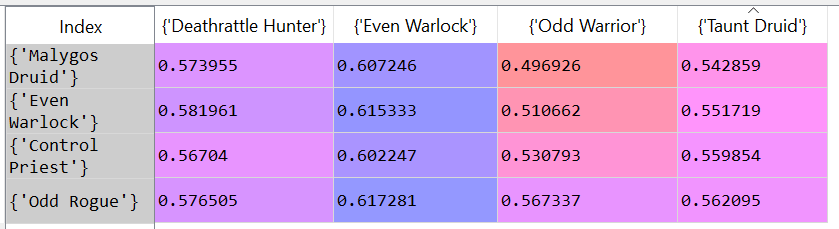
This is the same example I used in my part 1 post. To recap, Player 1 uses {Taunt Druid, Deathrattle Hunter, Even Warlock, Odd Warrior}, while Player 2 uses {Malygos Druid, Control Priest, Odd Rogue, Even Warlock}.
To find the optimal decision for Player 1, we need to go through the available ban options for Player 1, and find the highest minimum chance of winning. If Player 1 choose to ban Malygos Druid, his minimum chance of winning is 49.69%. If he bans Even Warlock, his minimum chance of winning is 51.06%. If he bans Control Priest, his minimum chance of winning is 53.08%. Lastly, if he bans Odd Rogue, his minimum chance of winning is 56.21%. Therefore, Player 1’s optimal ban decision is banning Odd Rogue, as it gives him the highest minimum chance of winning.
The same process applies for Player 2, except we are now finding the lowest maximum chance of winning. This is because Player 2 wants to minimise his chance of losing. If Player 2 choose to ban Deathrattle Hunter, his maximum chance of losing is 58.20%. If he bans Even Warlock, his maximum chance of losing is 61.73%. If he bans Odd Warrior, his maximum chance of losing is 56.73%. Lastly, if he bans Taunt Druid, his maximum chance of losing is 56.21%. Therefore, Player 2’s optimal ban decision is banning Taunt Druid, as it gives him the lowest maximum chance of losing.
In this situation, Player 1’s highest minimum chance of winning = Player 2’s lowest maximum chance of losing. This is an optimal situation as each player cannot improve his position with an alternate ban decision, given that the other player’s decision remain unchanged. This is also known as the Nash’s equilibrium. In this example, each player uses a pure strategy to achieve his optimal position.
A quick summary to find this optimal situation is to first figure out the maximum values for each column, and then the minimum values of each row, and finally there is an optimal win-rate when one of the maximum values equals one of the minimum values.
However, sometimes there is no pure strategy available for either player to achieve a Nash’s equilibrium.
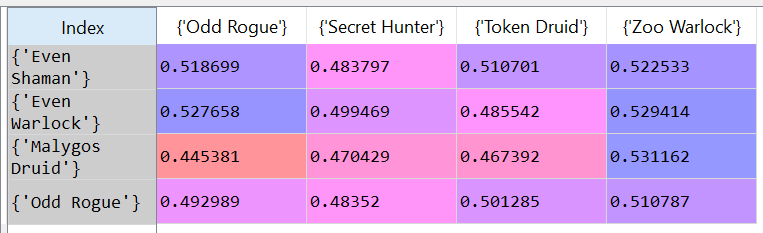
In the above example, the maximum values for each column are {52.77%, 49.95%, 51.07%, 53.12%} and the minimum values for each row are {48.38%, 48.55%, 44.54%, 48.35%}. As you can see none of the maximum values equals to any of the minimum values. There is no Nash equilibrium. We can verify this with an example: If Player 1 bans Even Warlock, Player 2 will ban Token Druid. If Player 2 sticks with his choice of Token Druid, Player 1’s best ban option then becomes banning Even Shaman. If Even Shaman is banned by Player 1, Player 2 would then choose to ban Secret Hunter instead. If Player 2 bans Secret Hunter, Player 1 would ban Even Warlock. And this would go in a loop, no equilibrium is established.
In this case, the optimal position can only be achieved by using a mixed strategy. This means that each player’s options are assigned a probability, p. This means that each player should choose an option based on the assigned probability. If the mixed strategy is 50% Odd Rogue, 50% Secret Hunter, Player 2 needs to randomly choose between these two options with the given probability (This is not the optimal mixed strategy for this case). In order to find the optimal mixed strategy, linear programming is required. I will not discuss any situation where mixed strategies are required as it’s not very easy to understand in my opinions. Hence, I will just cover pure strategies as they are much more obvious to most people.
Actual Matches
I have analysed a total 219 matches from this tournament. I had to exclude matches that involved the player Cheese and HockeyBoyz3 as their line-up included decks that did not have win-rate data available at HSReplay.
Let’s first take a look at some sample results.
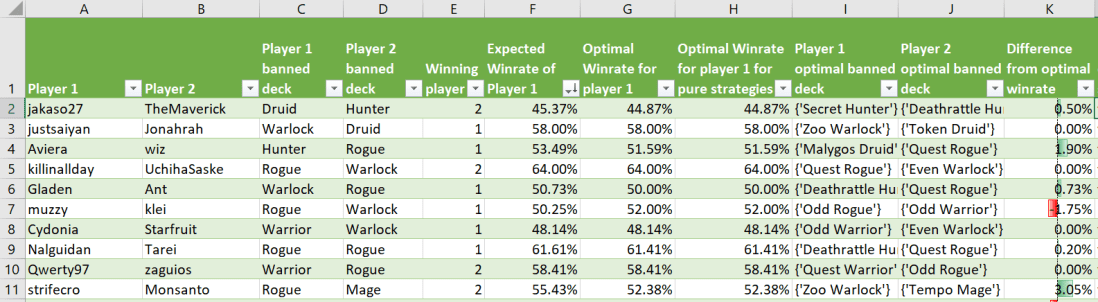
The header in this table should be quite self-explanatory. Just to clarify Columns C, D, I and J; they represents deck that has been banned from their line-up. Columns C and D are the actual ban made in the match while columns I and J are the optimal bans to be made. For example from row 2, jakaso27’s Druid deck was banned by TheMaverick and TheMaverick’s Hunter deck was banned by jakaso27. Column F is Player 1’s chance of winning given the actual ban decision. Column G and H are Player 1’s chance of winning given the optimal ban decisions. They are essentially the same except when mixed strategies are involved. Lastly, column K is the difference between the actual win-rate and the optimal win-rate. A positive difference means that the ban decisions were in favour of Player 1 i.e. Player 1’s chance of winning increased, while a negative difference means that the ban decisions were in favour of Player 2 i.e. Player 2’s chance of losing decreased. When both players used their optimal strategies, the difference is zero e.g. row 3 in the table.
Let’s take a look at some matches with positive difference.

As you can see, the largest positive difference is 7.16%! This is so large that it actually turns the match from unfavourable to a favourable match for lii. lii banned Odd Warrior from UchihaSaske’s line-up, which is an optimal decision. UchihaSaske banned the Combo Priest deck instead of Even Warlock, which is not optimal. This ultimately helped to swing the match to lii’s side, and probably helped lii to secure the win eventually. Below is a breakdown of the line-up win-rate table for this match.
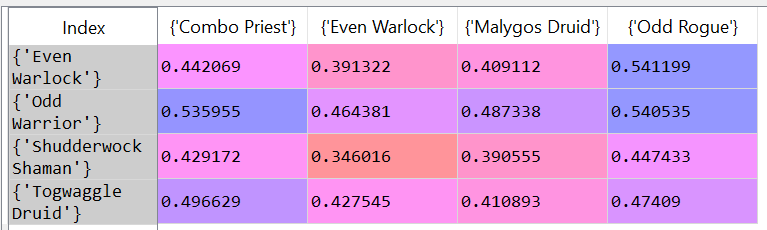
You can figure out yourself based on this table that indeed the optimal ban decision for lii is Odd Warrior and for UchihaSaske is Even Warlock. One possible reason that UchihaSaske banned Combo Priest could be that he is unfamiliar playing against Combo Priest.
Referring to the previous table, I would like to point out that in the Firebat vs Fled match, both players actually did not ban optimally. However, the bans were in favour of Firebat. Unfortunately, it did not change the match to be in Firebat’s favour at the end.
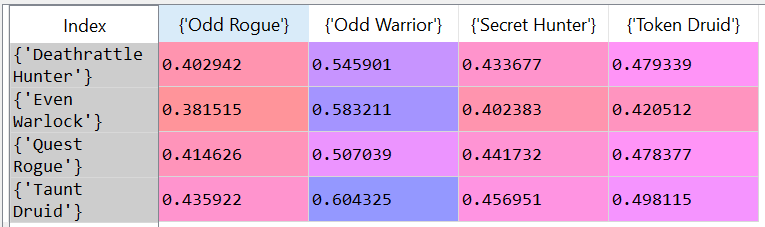
Let’s see what would be the win-rate like if either player had banned optimally, given the other player’s non-optimal choice. If Firebat banned Quest Rogue and Fled banned Odd Rogue instead, Fled’s chance of losing would be 41.46%, slightly improving Fled’s position to win the match. If Fled banned Token Druid and Firebat banned Taunt Druid instead, Firebat’s chance of winning would be 49.81%, just slightly below 50%. Perhaps, this could have helped Firebat to win the match otherwise.
Now let’s take a look at negative difference.

The largest negative difference is even bigger, at -10.35%! In this case, it greatly improved Lyme’s chance of winning. Let’s see the line-up win-rate table.
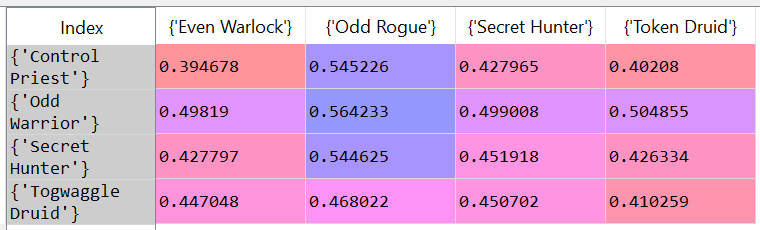
Lyme has made the optimal ban decision of banning away Even Warlock. Starfruit’s choice of Control Priest was not optimal as the optimal option was Odd Warrior.
Referring back to the negative difference table, you can see that in the Akatsu vs Ryder match, both players did not ban optimally. However, this time the ban is in favour of Player 2, Ryder.
Let’s do the same analysis as we did for the Firebat vs Fled match.
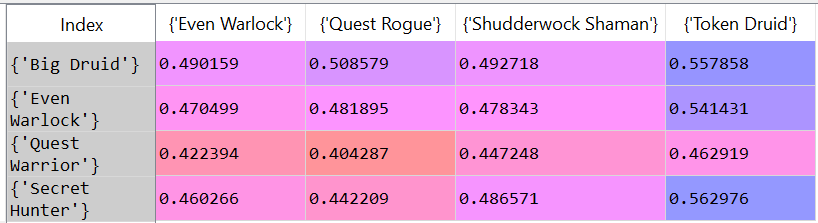
If Akatsu banned Odd Warrior and Ryder banned Even Warlock instead, Ryder’s chance of losing would be 47.05%, slightly improving Ryder’s position to win the match. If Ryder banned Quest Rogue and Akatsu banned Big Druid instead, Akatsu’s chance of winning would be 50.86%, turning the match to his favour. Perhaps, this could have helped Akatsu to secure the match.
Moving on
I hope that you have learnt something from this blog post, especially about optimising ban decision. You can clearly see that impact of ban decision on the win-rate of each player, sometimes swinging the favour of the match from one player to his opponent.
One reason that I could think of why players did not ban optimally is because their individual deck win-rate is different from the data that I have gathered from HSReplay. Ultimately, ban decisions are based on the individual experiences playing with and against certain decks.
I will continue to cover this event. Next up, I will look at which player has the best chance to succeed in this tournament given the composition of line-up in this tournament i.e. the tournament meta.
If you have any suggestions or query about my analysis, do contact me via email!
Cheers


One thought on “HCT Falls Americas Playoffs (Part 2 of 3)”